Monterey Hills is a Los Angeles neighborhood in ZIP 90042, about two miles west-northwest of Alhambra, a planned community of condominiums and townhomes built in the late 1970s and 1980s, with around 1,800 properties. Shared walls, stacked units, and common-area plumbing make leak detection here a special discipline: the stain on your ceiling may start two units away, and the leak detection specialist has to prove exactly where before anyone opens anything.
Alhambra Leak Pros works in multi-unit communities like Monterey Hills. Acoustic listening traces pressurized leaks through shared walls and slabs, thermal imaging maps moisture spread across units, and pressure testing isolates whether the failing line is yours, a neighbor's, or common area. Our documentation gives homeowners, HOAs, and property managers a clear, defensible answer about location, and responsibility.
Service ZIP codes: We serve homes and businesses across Monterey Hills, CA, including ZIP code 90032.
Last updated: October 13, 2026
About Leak Detection in Monterey Hills
Monterey Hills is a neighborhood in the City of Los Angeles (ZIP 90042), roughly two miles west-northwest of Alhambra. Built as a planned condominium and townhome community in the late 1970s and 1980s with about 1,800 properties, it has a distinct identity, and distinct leak-detection needs. Supply lines from that construction era are now decades old, and in attached housing a single leak can affect multiple units, which is why precise, documented location matters more here than almost anywhere we work.
Typical Monterey Hills scenarios we investigate:
Water stains appearing on a lower unit's ceiling
Damp drywall along shared walls between units
Common-area supply lines serving multiple homes
Unexplained HOA water bill increases
When a leak affects more than one unit, our process is designed to produce answers everyone can rely on. We test systematically, isolating lines with pressure testing, tracing with acoustic listening, mapping moisture with thermal imaging, until the origin is established and confirmed by a second method. The written documentation describes exactly what we tested, what we found, and where the leak is, which is what HOA boards and property managers need to determine responsibility and authorize repairs. Individual homeowners get the same thoroughness for in-unit issues like bathroom and kitchen supply leaks.
Monterey Hills residents typically call us about:
Ceiling stains or active dripping from the unit above
Damp carpet or flooring along shared walls
HOA common-area bills rising without explanation
Musty odors in closets, bathrooms, or hallways
Water heater or laundry supply lines in utility closets
Visible moisture around tub, shower, or toilet bases
Water stains on garage ceilings below living spaces
Dampness in utility closets shared between units
Services Available in Monterey Hills
Every Alhambra Leak Pros service is available here, including:
How pinpointing changes the job: 5 illustrative examples
The examples below are illustrative. They show how pinpointing typically changes a job. They are not reports of specific customer jobs, and they name no customer, address, date, or price.
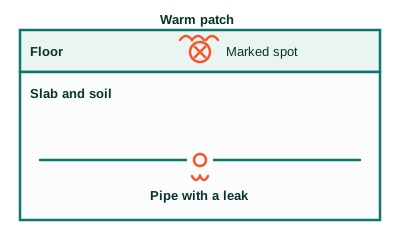
1. A warm spot on the floor
Illustration: Slab cross-section with one marked spot
Before: A homeowner notices one warm patch on the floor and a bill that keeps climbing, but no visible water. Without instruments, the only way to find the leak would be to open large areas of flooring and guess.
Method: The technician checks the meter, isolates the hot-water line, then combines thermal imaging with acoustic listening to follow the heat and sound to one point.
After: The leak is marked on the floor at one spot. Any repair opens that spot only, and the rest of the floor stays intact.
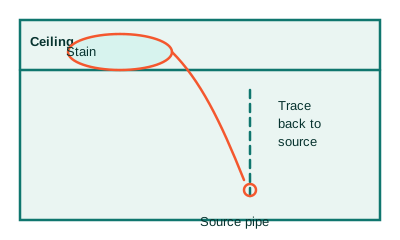
2. A stain on the ceiling
Illustration: Ceiling stain traced back to its source line
Before: A brown stain spreads across a ceiling, but the pipe above it may run several feet away. Opening the ceiling at the stain alone often misses the source and means opening more drywall later.
Method: The technician maps the damp area with thermal imaging and moisture readings, then checks pressure and nearby lines to trace the water back to its source.
After: The source line is identified and marked. Any opening is made where the leak actually is, not where the stain happens to show.
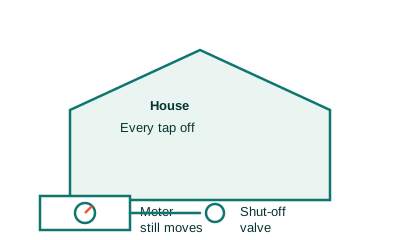
3. A meter that moves with everything off
Illustration: Meter test with every tap off
Before: Every tap is off, yet the water meter still moves. That proves water is leaving the system somewhere, but it says nothing about where. Digging or opening walls at this point would be pure guesswork.
Method: The technician runs a timed meter test, then isolates lines one by one with pressure checks to narrow the loss to a single line.
After: The search area shrinks from the whole property to one line. Pinpointing then focuses on that line only, before anything is opened.
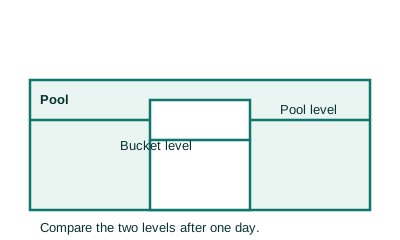
4. A pool that keeps losing water
Illustration: Bucket test comparing pool and bucket levels
Before: A pool loses water faster than normal, but some loss is normal evaporation. Draining the pool or digging up pipes without a test would waste water and money.
Method: The technician runs a bucket test to separate evaporation from a real leak, then pressure tests each line on its own to find which line loses pressure.
After: If the pool is only evaporating, no repair is needed. If one line fails, the search narrows to that line instead of the whole pool system.
5. Slow drains and a sewer odor
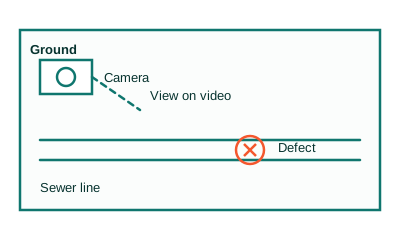
Illustration: Camera inspection showing a defect inside the line
Before: Drains run slow and a sewer odor lingers, but the blockage or break could sit anywhere along the line. Digging to find it would disturb the yard and still might miss the defect.
Method: The technician sends a camera through an existing access point and watches the inside of the line on video, marking where roots, cracks, or offsets appear.
After: The defect is seen on video and its position is known. Any digging happens at that one place, after the cause is already clear.
Frequently Asked Questions
Do you work in condo and townhome communities?
Yes, Monterey Hills is exactly the kind of community we serve. We work with individual homeowners, HOAs, and property managers, and our documentation helps establish where a leak originates when multiple units are involved.
Will detection disturb my neighbors?
Detection itself is quiet and non-invasive, sensors, scans, and tests through existing access points. No demolition, no digging. We keep disruption to a minimum for you and the units around you.
Can you tell whether a leak is mine or common area?
Our testing isolates which line is failing and where, and we document it. That documentation is what HOAs and property managers use to determine responsibility, though the final call is theirs, not ours.
What if water is coming through my ceiling right now?
Call +1 626-898-6221 immediately, any time of day or night. We will talk you through shutting off the right valve and arrange the earliest available visit. We never promise arrival times we can't keep.
Suspect a Hidden Leak? Don't Wait for the Damage.
Every day a hidden leak runs, the water bill climbs and the damage spreads. Call now, we answer 24 hours a day.