
Water where it should not be has a way of escalating fast: a pinhole becomes a spray, a spray becomes a flood, and every minute adds damage. Whether it is a burst pipe, a failed supply line, or a leak you just discovered spreading across the floor, the first ten minutes matter more than anything that follows. Here is the triage sequence, what to do, and in what order.
Last updated: October 13, 2026
What is the first thing to do when you find a water leak?
Stop the water. Everything else, mopping, moving furniture, calling for help, comes second. Find your main water shut-off valve and turn it off. In most Alhambra homes it is near the front of the house, in a garage or utility area, or at the meter box near the curb. The handle is usually a round wheel (turn clockwise to close) or a lever (turn it perpendicular to the pipe). If you do not know where yours is, find it today, during an emergency is the worst time to search for it.
Should I turn off the main water valve for a leak?
For any active, uncontrolled leak, yes, without hesitation. Shutting the main stops all water entering the house, which stops the damage from growing. The only common exception is a leak clearly isolated to one fixture with its own working shut-off valve, the small valves under sinks and behind toilets. If you can stop it there, you can keep water on for the rest of the house. When in doubt, shut the main. You can always turn it back on once the situation is under control. If your main valve is stuck or corroded, common in older homes, use the shut-off at the water meter near the curb instead; a meter key or wrench turns it.
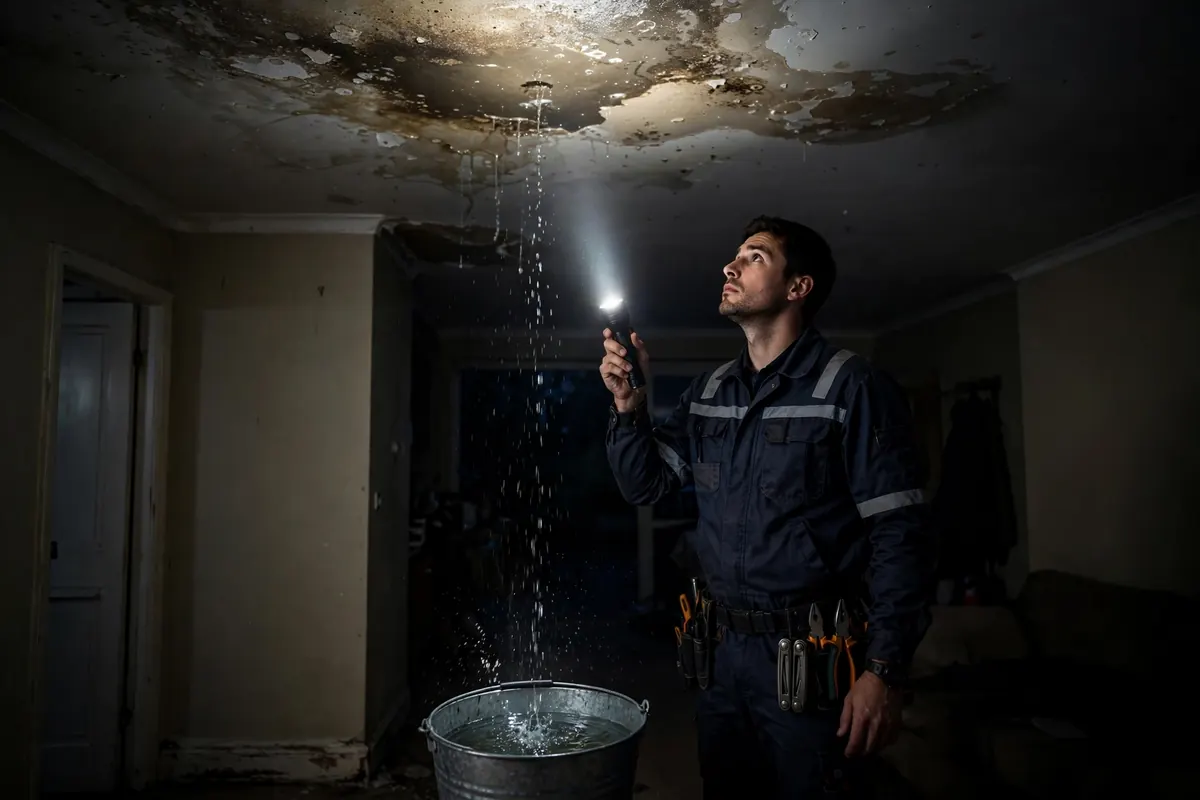
The first ten minutes: triage steps
Minutes 0–2: Shut off the water at the main valve, or at the fixture valve if the leak is clearly isolated to one spot.
- Shut off the water. Turn off the main valve, or the fixture valve if the leak is clearly isolated to one fixture.
- Kill power near the water. If water is approaching outlets, switches, appliances, or the electrical panel, turn off the breakers for the affected area. Do not touch wet electrical fixtures and do not stand in water near them.
- Relieve pressure. Open the lowest faucet in the house, often an outdoor hose bib, to drain remaining pressure from the lines and slow any residual flow.
- Protect what you can. Move valuables, electronics, and important documents away from the water, and place buckets or towels under active drips.
- Document and call. Photograph the leak, the affected areas, and any visible damage from multiple angles before cleanup begins, then call for professional help.
Minutes 2–4: Kill power near the water. If water is approaching outlets, switches, appliances, or the electrical panel, turn off the breakers for the affected area. Do not touch wet electrical fixtures and do not stand in water near them.
Minutes 4–6: Relieve pressure. Open the lowest faucet in the house, often an outdoor hose bib, to drain remaining pressure from the lines and slow any residual flow.
Minutes 6–8: Protect what you can. Move valuables, electronics, and important documents away from the water. Place buckets or towels under active drips.
Minutes 8–10: Document and call. Photograph the leak, the affected areas, and any visible damage from multiple angles before cleanup begins, this matters for insurance. Then call for professional help: +1 626-898-6221, answered 24 hours.
Is water near an electrical outlet dangerous?
Yes, this is the one safety rule that overrides everything else. Water conducts electricity, and a wet outlet, switch, or appliance can energize the water around it. Never touch a wet electrical fixture, never unplug something while standing in water, and never wade through water to reach the breaker panel, if the panel area itself is threatened, stay clear and wait for professionals. When in doubt, treat every wet electrical fixture as live.
When is a water leak an emergency, and when can it wait?
Act immediately: active flowing water you cannot stop at a fixture valve, water spreading across floors or through ceilings, bulging or sagging drywall, water near electrical systems, sewage backup, or a burst pipe.
Can usually wait for a scheduled visit: a slow drip you have contained with a bucket and a fixture valve, a small stable stain with no active moisture, or a suspected hidden leak with no visible water, a climbing bill, a warm floor spot. "Stable" should be verified by checking that it is not growing, not assumed from appearance.
Once the immediate crisis is controlled, the next question is where the water came from. Emergency water shut-off and leak isolation stops the damage; professional detection finds the source so it can be fixed once, properly. If you are dealing with an active leak in Alhambra right now, call +1 626-898-6221, we answer 24 hours a day.
What you can do yourself, and what to leave to a pro
You can shut off the main valve, move valuables and documents away from the water, place buckets under drips, and photograph the damage for insurance. Those steps stop the loss from growing and protect what matters.
Do not touch wet electrical fixtures, do not wade through water to reach the breaker panel, and do not open walls or cut pipe to chase the leak. If you smell gas, leave the building and call emergency services from outside, and do not switch lights on or off. Once the water is stopped, detection finds the source.
Related service: Emergency Water Shut-Off & Isolation in Alhambra, CA
How pinpointing changes the job: 5 illustrative examples
The examples below are illustrative. They show how pinpointing typically changes a job. They are not reports of specific customer jobs, and they name no customer, address, date, or price.
1. A warm spot on the floor
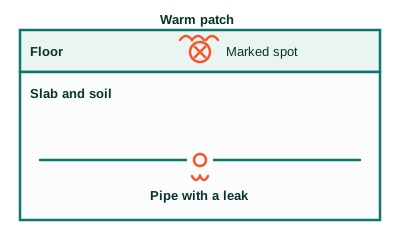
Before: A homeowner notices one warm patch on the floor and a bill that keeps climbing, but no visible water. Without instruments, the only way to find the leak would be to open large areas of flooring and guess.
Method: The technician checks the meter, isolates the hot-water line, then combines thermal imaging with acoustic listening to follow the heat and sound to one point.
After: The leak is marked on the floor at one spot. Any repair opens that spot only, and the rest of the floor stays intact.
2. A stain on the ceiling
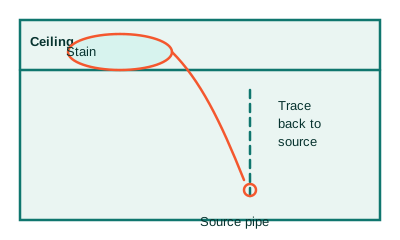
Before: A brown stain spreads across a ceiling, but the pipe above it may run several feet away. Opening the ceiling at the stain alone often misses the source and means opening more drywall later.
Method: The technician maps the damp area with thermal imaging and moisture readings, then checks pressure and nearby lines to trace the water back to its source.
After: The source line is identified and marked. Any opening is made where the leak actually is, not where the stain happens to show.
3. A meter that moves with everything off
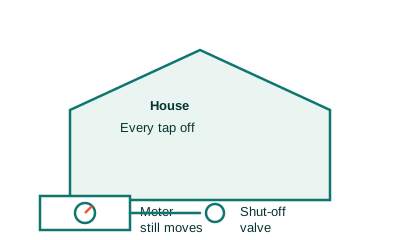
Before: Every tap is off, yet the water meter still moves. That proves water is leaving the system somewhere, but it says nothing about where. Digging or opening walls at this point would be pure guesswork.
Method: The technician runs a timed meter test, then isolates lines one by one with pressure checks to narrow the loss to a single line.
After: The search area shrinks from the whole property to one line. Pinpointing then focuses on that line only, before anything is opened.
4. A pool that keeps losing water
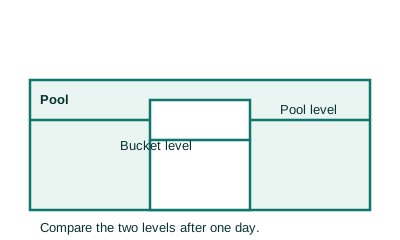
Before: A pool loses water faster than normal, but some loss is normal evaporation. Draining the pool or digging up pipes without a test would waste water and money.
Method: The technician runs a bucket test to separate evaporation from a real leak, then pressure tests each line on its own to find which line loses pressure.
After: If the pool is only evaporating, no repair is needed. If one line fails, the search narrows to that line instead of the whole pool system.
5. Slow drains and a sewer odor
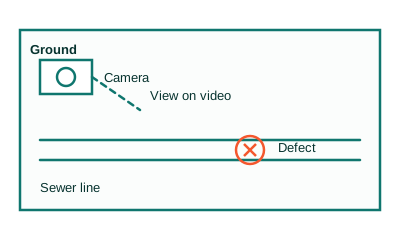
Before: Drains run slow and a sewer odor lingers, but the blockage or break could sit anywhere along the line. Digging to find it would disturb the yard and still might miss the defect.
Method: The technician sends a camera through an existing access point and watches the inside of the line on video, marking where roots, cracks, or offsets appear.
After: The defect is seen on video and its position is known. Any digging happens at that one place, after the cause is already clear.